McLeod Group guest blog by Nancy Burrows and Denis Côté, January 26, 2026
It is hard to remember what the world was like before Donald Trump returned to centre stage in U.S. politics and launched a new round of international chaos. But even before that, the global mood was already bleak.
In 2024, authoritarian governments were gaining ground in many regions. Right-wing populism was spreading. Attacks on women, migrants, LGBTQ+ people, Indigenous communities, and racialized groups were becoming more brazen, with hatred that had once been hidden now emboldened, openly legitimized and increasingly aggressive.
At the same time, wars were multiplying, climate disasters were intensifying, and inequality was deepening.
For organizations working in international cooperation and solidarity, the sense of urgency was clear. The old ways of doing things were no longer enough.
That is the context in which AQOCI – the Association québécoise des organismes de coopération internationale – decided to launch an ambitious, year-long collective process called the États généraux québécois de la solidarité internationale (Quebec International Solidarity Extensive Consultation).
The goal was simple but far-reaching: to step back and ask two big questions. What is preventing us from living in a fair and just world? And what can we do, together, to change that?
What followed was one of the largest collective reflection processes ever carried out in Quebec’s international solidarity sector.
Over twelve months, more than 1,000 people took part. They came from Quebec NGOs, social movements, unions, and community groups, as well as from across Canada and from Africa, Latin America, the Caribbean, and Asia. Many were people who experience the impacts of global injustice every day, not just people who study or fund international cooperation.
Between 2024 and 2025, AQOCI and its partners organized 28 participatory thematic dialogues – public forums, workshops, online consultations, and regional gatherings. Topics ranged from women’s rights and migration to climate change, food sovereignty, militarization, workers’ rights, and corporate power. Participants talked about shrinking civic space, racism, and colonial legacies.
What made the process different was not just its scale, but its spirit. It was not about producing another technical report or polished strategy. It was about listening and making room for disagreement. It was about recognizing that no single organization, or even one sector, can face today’s crises alone.
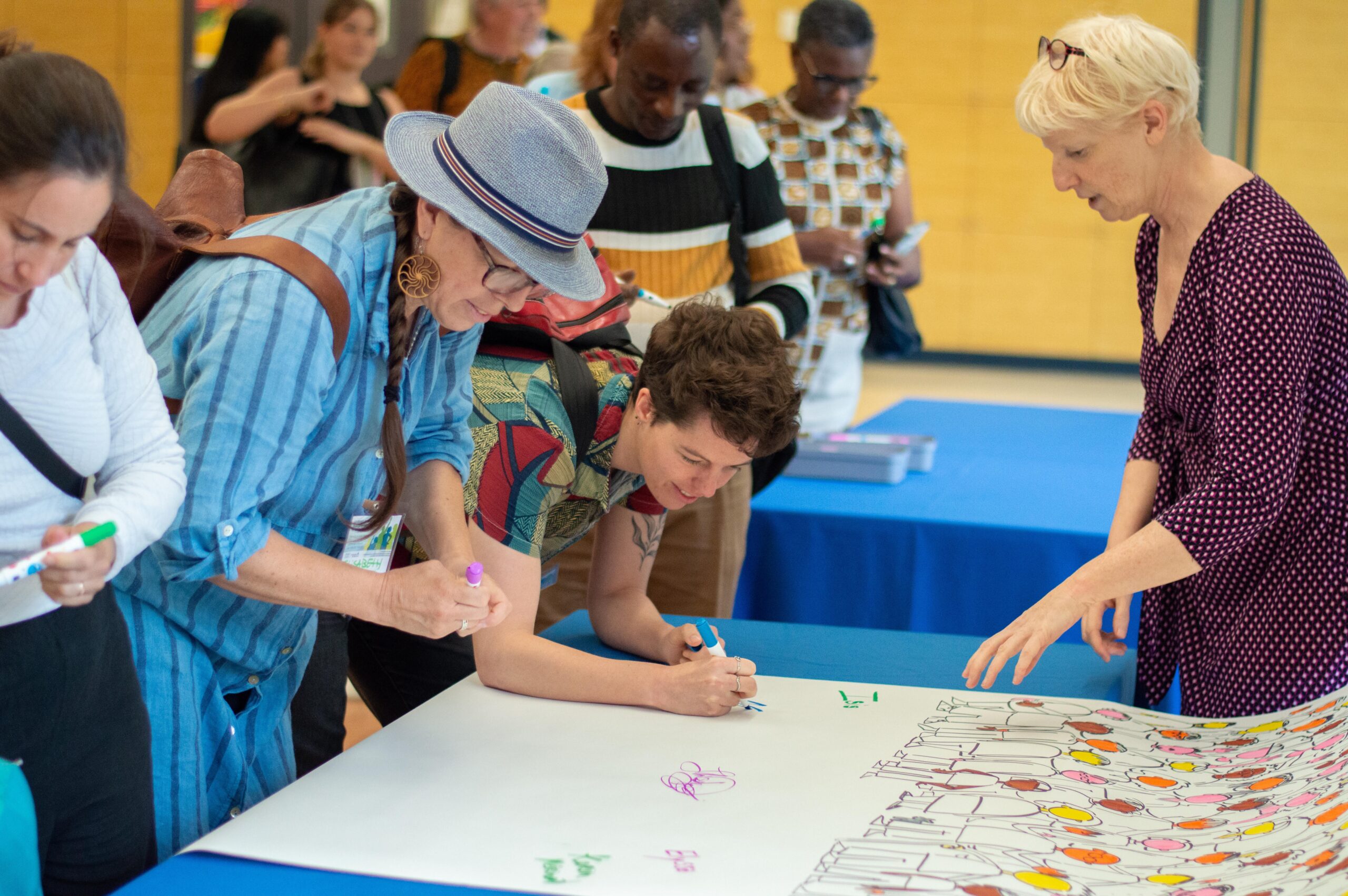
All of this led to a major gathering in Montreal in June 2025, the Forum of the Quebec International Solidarity Extensive Consultation. For three days, 400 people from across Quebec and around the world came together – long-time activists, international partners, youth leaders, NGO staff, and grassroots organizers. Together, they adopted a Declaration that sets out 28 shared commitments for Quebec civil society.
At its core, the Declaration can be summed up in three words: Connect. Advocate. Mobilize.
To connect means breaking out of silos and working across movements. Participants agreed that international solidarity groups cannot work only among themselves. They need deeper ties with diaspora communities, migrant-led organizations, Indigenous movements, labour unions, feminist groups, and climate justice networks. Global struggles are linked to local ones. The fight for decent work in Quebec connects to exploitation in global supply chains. Migrant rights here are tied to displacement and conflict elsewhere.
To advocate means being bolder and more political. The Declaration identifies areas where collective pressure is urgently needed: countering extractivism by Canadian mining, oil, and agribusiness corporations; demanding accountability for transnational companies; advancing climate justice, gender equality, and the right to food; defending Palestine and standing with Indigenous struggles; resisting militarization, arms exports, anti-immigration rhetoric, and the far right’s assault on human rights; and fighting disinformation.
To mobilize means moving from words to action. Alongside long-term goals, the Declaration includes short-term priorities and concrete steps – and some are already taking shape.
In October 2025, 16,000 people marched through Quebec City during the World March of Women to affirm feminist values that place dignity, solidarity, and respect for all living beings at the heart of collective decision-making. Activists have continued to mobilize around Palestine, taking to the streets to oppose the genocide and campaigning against the complicity of the Caisse de dépôt et placement du Québec, which invests in companies supplying equipment used to destroy Palestinian homes and infrastructure, and calling for the closure of Quebec’s office in Israel. New networks are challenging militarization in Canada and organizing to counter the rise of far-right movements, while dialogue between migrant groups, diaspora organizations, and international NGOs is reshaping how people work together.
Yet all this is happening as the ground shifts beneath international solidarity.
Since the États généraux began, the international aid landscape has been shaken. The United States has dismantled key parts of USAID. The United Kingdom, France, and Germany have cut aid budgets. Canada has reduced international assistance, and Quebec has abruptly withdrawn fundng from several international solidarity organizations, while sharply cutting support for work in Haiti.
In other words, solidarity is needed most urgently at the very moment government support is collapsing.
Yet the États généraux showed something vital. Even in hard times, people are willing to come together. They are ready to rethink old models. They are ready to act.
In 2024, the global solidarity infrastructure was already fracturing. Since then, attacks on democratic institutions, human rights, and planetary survival have intensified. But the process in Quebec made one thing clear: civil society is not standing still. Across borders and movements, people are organizing for justice, dignity, and a livable future.
That work is not optional. It is the work of our time.
Nancy Burrows is a Program Officer for Global Citizenship Education at AQOCI. Denis Côté is the Policy Analyst at AQOCI. Image: Participants signing the Declaration of Commitment on the last day of the forum (photo credit: Laure Carpentier).
.